Reef Tribe
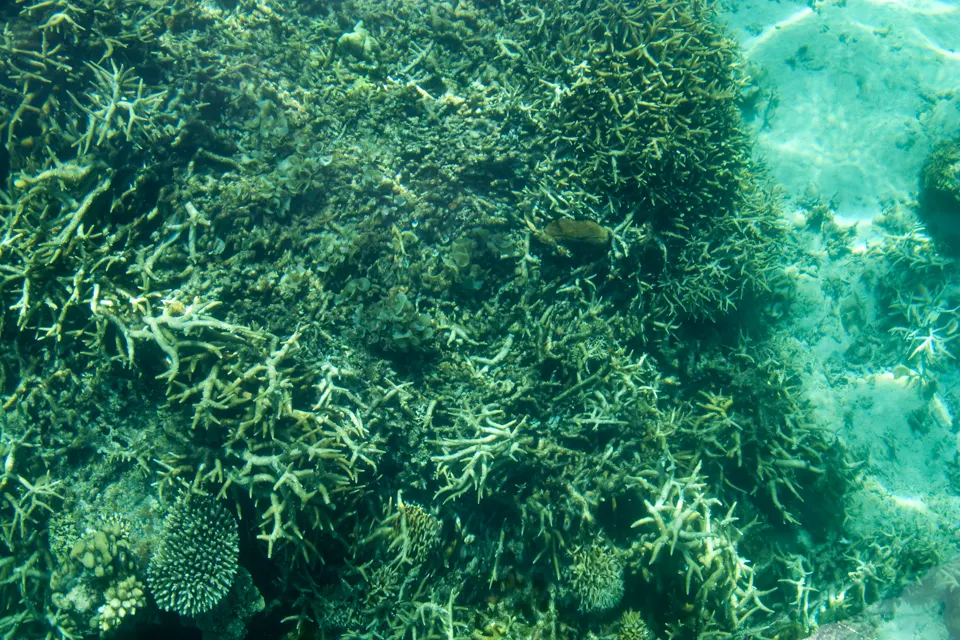
Underwater coral in turquoise water, Bacuit Bay, El Nido

Reef Zones / Zone 8

Zone 8: Science & Monitoring

If you cannot measure survival, growth, genetic mix, and ecological function, you do not know whether restoration worked.

PreserveConserveRestoreProtectRegenerate

Photo: Vyacheslav Argenberg, CC BY 4.0

Sample game plan

The three lowest-effort first moves for this Reef Zone. Cost levels are qualitative estimates, not quotes.

3

Line up community survey training

Why it matters

Reef Check-style protocols let trained volunteers collect comparable data (Reef Check).

What it takes

People
Coordinator + Filipino trainers
Time
1–2 months to arrange
Cost
Low to moderate
Permits & partners
Surveys led by Filipino partners with PAMB awareness

Roadmap

Monitoring is what turns good intentions into evidence. Without a baseline, nobody can say whether protection, cleaner water or restoration made a difference at a site. This roadmap starts with choosing methods on paper and grows into a long-running, partner-led record.

From the easiest work to the most advanced. In planning, and not legal advice.

  1. Stage 1: Beginner

    Monitoring comes before planting. Choose a framework on paper using the restoration monitoring guide (Goergen et al. 2020, restoration monitoring guide), the manager’s guide (Shaver et al. 2020, manager's guide) and GCRMN indicators (GCRMN, Status of Coral Reefs of the World: 2020): live coral cover, bleaching, recruits, fish and water-quality indicators. Collect existing regional baselines, such as long-term Apo Island studies (Russ et al. 2004, marine reserve benefits local fisheries (Apo and Sumilon, Negros Oriental)), UP Visayas assessments in Antique (UP Visayas CFOS-IMFO, coral reef assessment training in Antique) and Malampaya Foundation’s reports on coral cover, bleaching and Crown-of-Thorns in northern Palawan (Malampaya Foundation, 2025 Chairman’s Report). This stage is desk work and costs little. Decide in advance how often sites will be surveyed, who keeps the data, and how photos and records are stored so that results can be compared over many years.

    Ready for the next step when: The monitoring framework and existing baselines are compiled.

  2. Stage 2: Intermediate

    With Filipino partners and PAMB awareness, help resource a baseline survey led by local scientists, for example Silliman IEMS, which ran fish visual census training in Davao Oriental in 2026 (Silliman University, 29 Jun 2026 — SU-IEMS fish visual census training, Davao Oriental), MSU at Naawan (MSU at Naawan, Coral Reef Management (CoReM) Hub) or WPU in Palawan (Palawan News, 13 Oct 2025 — WPU, DENR-MIMAROPA and PSU MOA for El Nido research stations). Train community surveyors through existing networks such as Reef Check (Reef Check) instead of inventing a private method. Add social measures too: Hein et al. found 88% of transplantation studies judged success only by fragment growth and survival (Hein et al. 2017), and argue for socio-ecological indicators (Hein et al. 2021). Pair reef surveys with simple water-quality and visitor-use records, so changes in coral can be linked to likely causes. Publish methods openly so others can check the work.

    Ready for the next step when: A partner-led baseline survey is done, and local surveyors are trained.

  3. Stage 3: Advanced

    Keep monitoring longer than the typical project. Hein et al. found only 5% of studies monitored more than five years (Hein et al. 2017). A ten-year plan with partners, shared openly where DENR, BFAR and the LGU allow, would make site data useful to national and Coral Triangle reporting. Any coral or in-water step is led by a Filipino institution that holds the BFAR permits, under a written MOA. The center funds and supports; coral is never sold; and education stays non-formal. Good monitoring is how every other Reef Zone learns what works. Revisit the plan every year with partners, retire metrics that are not useful, and add ones the community asks for, such as fish catch or tourism pressure.

    Ready for the next step when: A multi-year monitoring plan is funded and its data shared with agencies.

Why it matters

Topics this Reef Zone will cover

How it connects

Feeds every Reef Zone (adaptive management). Is fed by all field Reef Zones (the data) and Philippines (local methods, UP MSI and partners).

Key sources

Videos

Interview with Richard Vevers of the Ocean Agency (Coralpalooza Digital 2020)Coral Restoration Foundation · 12:42 · Zone 8: Science & MonitoringCRF interviews Richard Vevers of The Ocean Agency on imaging, public communication, and why documentation matters.Watch on YouTube ↗
Liz Shaver: Reef to Reef: Sharing knowledge with the Reef Resilience NetworkReef and Rainforest Research Centre · 12:00 · Zone 8: Science & MonitoringLiz Shaver (lead author of NOAA's Manager's Guide) on sharing restoration planning knowledge through the Reef Resilience Network.Watch on YouTube ↗

Books

Research library

Filter this Reef Zone’s papers by the action they help you take — Preserve, Conserve, Restore, Protect or Regenerate.

Loading research for this Reef Zone…

Philippines action plan

Monitoring should come before planting. A program at any Philippine site would follow published methods and be carried out with Filipino scientists and, where it applies, Reef Check or similar community protocols.

In planning, and not legal advice. This is a working educational plan for a center that is not yet operating or permitted. Confirm every permit with Philippine counsel, BFAR, DENR (including the Biodiversity Management Bureau and the Protected Area Management Board of any protected area), DENR-EMB, the relevant LGU and, in Palawan, the PCSD, before any field work.

Who can lead in-water coral work. Gathering, possessing, selling or exporting corals is generally unlawful in the Philippines, except for scientific or research purposes under a special permit from the Department of Agriculture / BFAR (Philippine Fisheries Code of 1998, Sec. 91 (RA 8550); BFAR FAO 202, s. 2000, Ban on Coral Exploitation and Exportation). Collection and conservation breeding of aquatic wildlife, including coral, is also regulated under FAO 233, issued pursuant to the Wildlife Act, and typically requires a Gratuitous Permit or related BFAR authority (FAO 233 (2010), Aquatic Wildlife Conservation; FAO 233 text (FAOLEX); Wildlife Resources Conservation and Protection Act (RA 9147)). The Constitution reserves exploration, development and utilization of natural resources to Filipino citizens or corporations at least 60% Filipino-owned, and the 13th Regular Foreign Investment Negative List reserves utilization of marine resources in archipelagic waters, the territorial sea and the EEZ to Philippine nationals (1987 Constitution, Art. XII, Sec. 2; 13th Regular Foreign Investment Negative List (EO 113, s. 2026)). For those reasons, any in-water coral work contemplated here would be led by Filipino scientific and community partners, not by a foreign principal acting alone.

The permit chain (to be confirmed site by site, anywhere in the Philippines) generally includes: review by the Protected Area Management Board where a site lies inside a protected area under the Expanded NIPAS Act (Expanded NIPAS Act of 2018 (RA 11038)); an Environmental Compliance Certificate or Certificate of Non-Coverage from DENR-EMB under the EIS System (PD 1586 / Philippine EIS System (DENR-EMB ECC/CNC)); BFAR authority for any coral handling; and local government permits. Municipal fisherfolk have preferential rights in municipal waters under the Fisheries Code. Some regions add their own layer. In Palawan, for example, that means Palawan Council for Sustainable Development (PCSD) zoning/ECAN certification and SEP clearance under RA 7611 (Strategic Environmental Plan for Palawan Act (RA 7611)); and, at El Nido, review by the Protected Area Management Board of the El Nido–Taytay Managed Resource Protected Area (Presidential Proclamation No. 32, s. 1998 (ENTMRPA)).

Existing work across the country. Filipino institutions already lead reef science and restoration nationwide: the University of the Philippines Marine Science Institute and the Marine Environment and Resources Foundation in Bolinao and beyond (UP MSI coral cryobank announcement; MERF / ACIAR coral larval restoration project); Silliman University’s Institute of Environmental and Marine Sciences in the Visayas and Mindanao (Silliman University, 10 Dec 2025 — SU-IEMS coral reef restoration research; Silliman University, 29 Jun 2026 — SU-IEMS fish visual census training, Davao Oriental); UP Visayas (UP Visayas CFOS-IMFO, coral reef assessment training in Antique); Mindanao State University at Naawan (MSU at Naawan, Coral Reef Management (CoReM) Hub); Davao Oriental State University in Pujada Bay (DORSU, 23 Jul 2025 — Pujada Bay artificial reef results); the Coastal Conservation and Education Foundation (CCEF, Aug 2024 — 3D-printed clay reef workshop, Maria, Siquijor); and local programs such as the El Nido Foundation in Palawan (El Nido Foundation, Coral Reef Restoration and Education Program). A planned center should complement that work, not overwrite it. A public record of past work is not a partnership agreement, and current BFAR permit numbers were not independently verified for this page.
First 90 days

Year 1

Longer term

Learning path

A beginner-to-expert arc: start with why the work matters, then methods and sources, then local application with Filipino partners.

Beginner

Learn common metrics: live coral cover, bleaching, recruits, and why a baseline matters before anyone plants.

Intermediate

Work through Goergen et al. (2020), Shaver et al. (2020) and Reef Check / GCRMN methods, and Hein et al. (2017) on how rarely projects monitor for more than a year.

Expert

Help Filipino partners write a monitoring plan with socioecological indicators and a data-sharing path.

Key organizations & tools

These are other organisations’ resources and public programs. Listing them is not a partnership claim.

Glossary & FAQ

Answers are limited to points we can cite from the research library or from official and peer-reviewed sources. Questions we cannot answer that way are left out.

How to monitor coral reefs?

Standard programs measure live coral cover, bleaching, recruits and sometimes fish and algae, using fixed methods such as Reef Check, AGRRA, or the restoration monitoring steps in Goergen et al. (2020) and the manager’s guide by Shaver et al. (2020). Goergen et al. 2020, restoration monitoring guide; Reef Check

What is coral cover?

Live hard-coral cover is the share of the reef surface occupied by living hard coral. It is a core GCRMN and Reef Check metric and the main global trend indicator in Status of Coral Reefs of the World reports. GCRMN, Status of Coral Reefs of the World: 2020

What is coral bleaching?

Bleaching is the loss of the coral’s symbiotic algae under stress, often heat. Hughes et al. document how mass bleaching has become more frequent and how severe heat can transform reef assemblages. Hughes et al. 2017; Hughes et al. 2018, reef assemblages