Reef Tribe
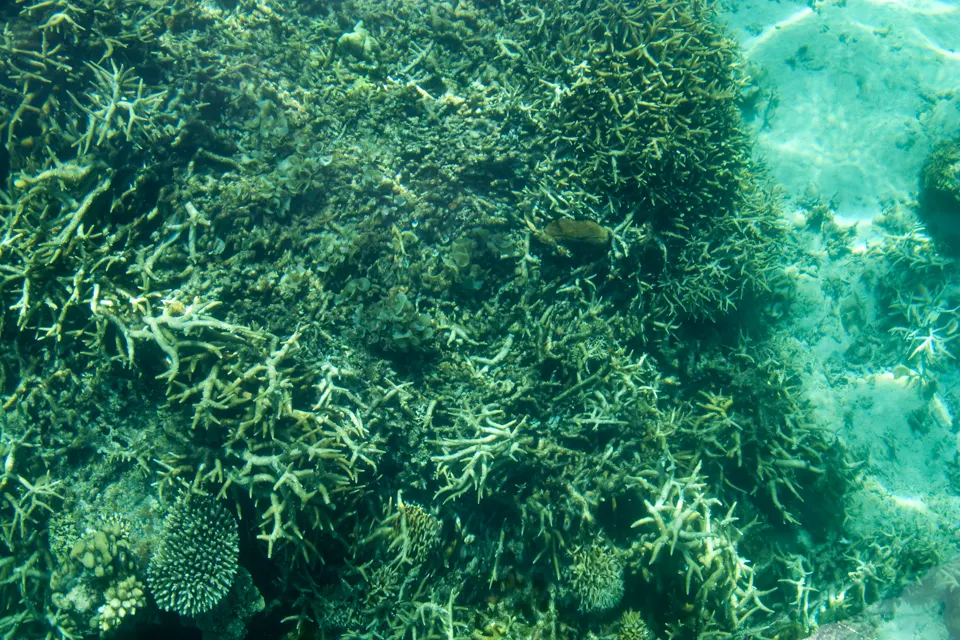
Underwater coral in turquoise water, Bacuit Bay, El Nido

Action Plans / Action Plan 1

Action Plan 1: Preservation & Protection

Keep living reefs alive first. No coral nursery can replace a well-guarded area where fishing is banned, or a plan for the next coral bleaching event.

PreserveConserveRestoreProtectRegenerate

Sample game plan

The three lowest-effort first moves for this Action Plan. Cost levels are qualitative estimates, not quotes.

1

Map what is already protected

Why it matters

You cannot protect what you have not located. MPA results depend on management capacity, not just a line on a map (Gill et al. 2017, MPA management capacity).

What it takes

People
1 researcher, desk-based
Time
2–4 weeks
Cost
Low (staff time only)
Permits & partners
None for desk work; uses public DENR-BMB, PAMB and LGU documents (plus PCSD in Palawan)
2

Share one bleaching briefing

Why it matters

Warming now drives repeated mass bleaching, so local partners need the same evidence base (Hughes et al. 2017; Hughes et al. 2018, bleaching intervals).

What it takes

People
1 writer + 1 Filipino reviewer
Time
2–3 weeks
Cost
Low
Permits & partners
None; informal, non-formal education
3

Back the moorings and visitor briefings

Why it matters

Anchor and fin damage are avoidable. Briefings and mooring use protect reefs without anyone handling coral.

What it takes

People
Tour operators, Bantay Dagat, LGU tourism office
Time
1–3 months
Cost
Low to moderate
Permits & partners
LGU and PAMB coordination; no coral permit needed

Roadmap

Protection is the first Action Plan because it is the cheapest way to keep coral alive. Across the Philippines, many reefs already have protected-area rules, moorings and local programs, from Apo Island to Tubbataha, so this roadmap is about strengthening what is there before adding anything new. Each stage is gated by a checkpoint, and the in-water steps stay with Filipino partners and agencies.

From the easiest work to the most advanced. In planning, and not legal advice.

  1. Stage 1: Beginner

    Start on land and on paper. Gather the public rules for protected areas under the Expanded NIPAS Act (Expanded NIPAS Act of 2018 (RA 11038)), municipal no-take zones and mooring sites, and LGU tourism rules at candidate sites. Learn from the national model: Apo Island and Sumilon in Negros Oriental, where decades of study linked community-run no-take reserves to more fish and better local catches (Russ et al. 2004, marine reserve benefits local fisheries (Apo and Sumilon, Negros Oriental); Russ and Alcala 1999, management histories of Sumilon and Apo marine reserves). Read existing local programs, such as the El Nido Foundation in Palawan (El Nido Foundation, Coral Reef Restoration and Education Program), so a new center supports work already under way. Write one shared briefing on why warming now causes repeated mass bleaching, drawing on Hughes et al. 2017; GCRMN, Status of Coral Reefs of the World: 2020. None of this touches the reef, so it can begin immediately and costs only staff time. The goal of this stage is a clear, sourced picture of what is protected, by whom, and how well.

    Ready for the next step when: A sourced map of a candidate site’s protected areas, moorings and managers exists, and partners have reviewed the bleaching briefing.

  2. Stage 2: Intermediate

    Move from reading to supporting the people who already protect the bay. Gill and colleagues found that MPA outcomes track staff and budget capacity, not designation alone (Gill et al. 2017, MPA management capacity). So this stage asks where capacity is thin: mooring maintenance, Bantay Dagat patrol support, visitor briefings, and damage reporting by boat crews. Offer non-formal seminars for barangays and tour operators on bleaching, herbivores and fishing rules. If the PAMB and Filipino partners, such as Silliman University’s IEMS in the Visayas (Silliman University, 10 Dec 2025 — SU-IEMS coral reef restoration research), UP MSI, or regional groups like Malampaya Foundation in Palawan (Malampaya Foundation, 2025 Chairman’s Report), want it, help resource a condition baseline that they lead. Keep every activity on the protection side: no collecting, no planting.

    Ready for the next step when: Partners agree on which protection gaps the center can help fill, and a partner-led baseline is planned or done.

  3. Stage 3: Advanced

    With protection, water quality and monitoring in place, partners can plan a bleaching-response protocol: who checks heat-stress alerts, who surveys after an event, and how results are shared with DENR, BFAR, the LGU and any regional body such as Palawan’s PCSD. Hughes and colleagues showed the gap between severe bleaching events is shrinking (Hughes et al. 2018, bleaching intervals), so this plan should assume repeat events. Only after this foundation exists should active restoration be considered, and then under Filipino scientific leadership and BFAR authority. Any coral or in-water step is led by a Filipino institution that holds the BFAR permits, under a written MOA. The center funds and supports; coral is never sold; and education stays non-formal. The long-term marker of success is reef that stays alive and protected, reported honestly, not a count of corals planted.

    Ready for the next step when: A written bleaching-response plan is shared with agencies, and any restoration proposal has a Filipino lead and permits.

Why it matters

Restoration fails, or is wasted, if the same fishing, anchoring, and heat-stress conditions that killed the reef are still in place.

Topics this Action Plan will cover

How it connects

Feeds every other Action Plan. Is fed by Water Quality, Community & Tourism (compliance and livelihoods), and Science & Monitoring (what to protect and whether it is working).

Key sources

Videos

Chasing Coral | Official Trailer [HD] | NetflixNetflix · 1:51 · Action Plan 1: Preservation & ProtectionOfficial trailer for the documentary that brought mass bleaching to a wide audience. Link the trailer only; the full film is on Netflix, not copied here.Watch on YouTube ↗

Books

Research library

Filter this Action Plan’s papers by the action they help you take — Preserve, Conserve, Restore, Protect or Regenerate.

Loading research for this Action Plan…

Philippines action plan

The first job anywhere in the Philippines is to help protect reefs that are still alive, including existing marine protected areas and the work already under way, before any planting is planned. Apo Island’s community-run reserve is the national proof that protection pays: long-term studies there and at Sumilon linked no-take reserves to higher fish biomass and local catches (Russ et al. 2004).

In planning, and not legal advice. This is a working educational plan for a center that is not yet operating or permitted. Confirm every permit with Philippine counsel, BFAR, DENR (including the Biodiversity Management Bureau and the Protected Area Management Board of any protected area), DENR-EMB, the relevant LGU and, in Palawan, the PCSD, before any field work.

Who can lead in-water coral work. Gathering, possessing, selling or exporting corals is generally unlawful in the Philippines, except for scientific or research purposes under a special permit from the Department of Agriculture / BFAR (Philippine Fisheries Code of 1998, Sec. 91 (RA 8550); BFAR FAO 202, s. 2000, Ban on Coral Exploitation and Exportation). Collection and conservation breeding of aquatic wildlife, including coral, is also regulated under FAO 233, issued pursuant to the Wildlife Act, and typically requires a Gratuitous Permit or related BFAR authority (FAO 233 (2010), Aquatic Wildlife Conservation; FAO 233 text (FAOLEX); Wildlife Resources Conservation and Protection Act (RA 9147)). The Constitution reserves exploration, development and utilization of natural resources to Filipino citizens or corporations at least 60% Filipino-owned, and the 13th Regular Foreign Investment Negative List reserves utilization of marine resources in archipelagic waters, the territorial sea and the EEZ to Philippine nationals (1987 Constitution, Art. XII, Sec. 2; 13th Regular Foreign Investment Negative List (EO 113, s. 2026)). For those reasons, any in-water coral work contemplated here would be led by Filipino scientific and community partners, not by a foreign principal acting alone.

The permit chain (to be confirmed site by site, anywhere in the Philippines) generally includes: review by the Protected Area Management Board where a site lies inside a protected area under the Expanded NIPAS Act (Expanded NIPAS Act of 2018 (RA 11038)); an Environmental Compliance Certificate or Certificate of Non-Coverage from DENR-EMB under the EIS System (PD 1586 / Philippine EIS System (DENR-EMB ECC/CNC)); BFAR authority for any coral handling; and local government permits. Municipal fisherfolk have preferential rights in municipal waters under the Fisheries Code. Some regions add their own layer. In Palawan, for example, that means Palawan Council for Sustainable Development (PCSD) zoning/ECAN certification and SEP clearance under RA 7611 (Strategic Environmental Plan for Palawan Act (RA 7611)); and, at El Nido, review by the Protected Area Management Board of the El Nido–Taytay Managed Resource Protected Area (Presidential Proclamation No. 32, s. 1998 (ENTMRPA)).

Existing work across the country. Filipino institutions already lead reef science and restoration nationwide: the University of the Philippines Marine Science Institute and the Marine Environment and Resources Foundation in Bolinao and beyond (UP MSI coral cryobank announcement; MERF / ACIAR coral larval restoration project); Silliman University’s Institute of Environmental and Marine Sciences in the Visayas and Mindanao (Silliman University, 10 Dec 2025 — SU-IEMS coral reef restoration research; Silliman University, 29 Jun 2026 — SU-IEMS fish visual census training, Davao Oriental); UP Visayas (UP Visayas CFOS-IMFO, coral reef assessment training in Antique); Mindanao State University at Naawan (MSU at Naawan, Coral Reef Management (CoReM) Hub); Davao Oriental State University in Pujada Bay (DORSU, 23 Jul 2025 — Pujada Bay artificial reef results); the Coastal Conservation and Education Foundation (CCEF, Aug 2024 — 3D-printed clay reef workshop, Maria, Siquijor); and local programs such as the El Nido Foundation in Palawan (El Nido Foundation, Coral Reef Restoration and Education Program). A planned center should complement that work, not overwrite it. A public record of past work is not a partnership agreement, and current BFAR permit numbers were not independently verified for this page.

First 90 days

Year 1

Longer term

Learning path

A beginner-to-expert arc: start with why the work matters, then methods and sources, then local application with Filipino partners.

Beginner

Learn why reefs matter and why warming now causes repeated mass bleaching (Hughes et al. 2017, 2018; GCRMN 2020). Know the difference between protection and planting.

Intermediate

Read how MPA performance depends on management capacity (Gill et al. 2017) and how bleaching intervals have shortened (Hughes et al. 2018). Map a site’s existing protected-area rules from official sources.

Expert

Design, with Filipino partners, a protection-first plan: enforcement, moorings, bleaching response and honest public reporting — still without collecting coral unless BFAR authority exists.

Key organizations & tools

These are other organisations’ resources and public programs. Listing them is not a partnership claim.

Glossary & FAQ

Answers are limited to points we can cite from the research library or from official and peer-reviewed sources. Questions we cannot answer that way are left out.

Why should we protect coral reefs?

Reefs are among the most diverse marine ecosystems, and global assessments show they have already lost large amounts of coral to bleaching and other disturbances — in the 1998 bleaching event, 8% of the world’s coral died in one year, and from 2009 to 2018, the world lost 14% more of its coral, according to GCRMN 2020. Protection of what remains is the first step this library recommends. GCRMN, Status of Coral Reefs of the World: 2020

What are the biggest threats to coral reefs?

Recurrent mass bleaching driven by global warming is now a dominant threat (Hughes et al. 2017, 2018). Local pressures — poor water quality, destructive fishing, and poorly managed tourism — still matter, and GCRMN 2020 says recovery happens when conditions allow. Hughes et al. 2017; Hughes et al. 2018, bleaching intervals; GCRMN, Status of Coral Reefs of the World: 2020

How to save coral reefs from bleaching?

Hughes et al. (2017) found that the 2016 Great Barrier Reef bleaching was unprecedented in scale and that local water quality and fishing pressure had little influence on its severity; they conclude that preventing further warming is essential. Local protection still helps reefs recover between heatwaves, which are now more frequent (Hughes et al. 2018). Hughes et al. 2017; Hughes et al. 2018, bleaching intervals

Can we save the coral reefs?

GCRMN 2020 reports that reefs can recover when conditions allow, and that the East Asian Seas, including the Coral Triangle, had on average more coral in 2019 than in 1983. That is not a guarantee: the 2025 GCRMN assessment warns that bleaching every 5–6 years is expected to keep reefs declining unless emissions cuts are combined with local management. GCRMN, Status of Coral Reefs of the World: 2020

Next step