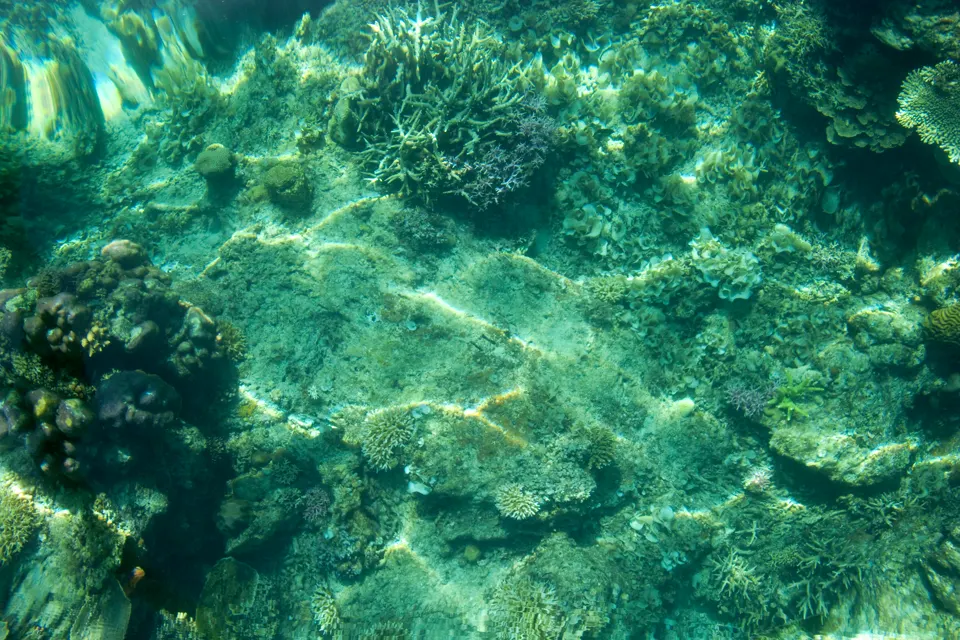
Washing dishes in a tub with phosphate-free soap and landing the greywater keeps nutrients off the reef. RA 9275 already sets the clean-water policy (Philippine Clean Water Act of 2004 (RA 9275)).
Voluntary; no PH sunscreen ban was found, so make no legal claims
Roadmap
Clean water decides whether every other Action Plan can work. Philippine reefs near towns and tourism hubs face familiar pressures: sewage, runoff from construction and roads, and heavy boat traffic. This roadmap moves from cheap habits and desk research to supporting the municipal systems that make the real difference.
From the easiest work to the most advanced. In planning, and not legal advice.
Ready for the next step when: The drainage desk review is complete, and at least a few boats are using the dish-wash practice.
Stage 2: Intermediate
Turn habits into a small, measured trial. With the LGU and boat associations, track how many boats adopt the dish-wash practice and what guests think of the briefing. If a local producer wants to trial a mineral sunscreen or a phosphate-free boat soap, keep the run small and the label ingredient-honest; this review found no Philippine rule that defines “reef-safe,” so no legal claim is made. Ask Filipino scientists, such as UP MSI, Silliman IEMS or WPU, which signed a 2025 MOA for new research stations in El Nido, Palawan (Palawan News, 13 Oct 2025 — WPU, DENR-MIMAROPA and PSU MOA for El Nido research stations), whether a simple bioindicator plan (Cooper et al. 2009, water-quality bioindicators) would help them track water quality over time.
Ready for the next step when: Trial results are written up, and Filipino scientists have chosen whether to run a bioindicator plan.
Stage 3: Advanced
The interventions that change reef water quality most are municipal: sewage treatment, stormwater control, and upland erosion control. The center’s advanced role is to support the LGU and DENR-EMB on those systems with evidence, education and, where welcome, funding, rather than running parallel infrastructure. Continue the product pilots only if the trial data, partners and the LGU support it. Report results openly, including what did not work. Any coral or in-water step is led by a Filipino institution that holds the BFAR permits, under a written MOA. The center funds and supports; coral is never sold; and education stays non-formal. Clean water raises the odds that every later Action Plan, from nurseries to larval work, succeeds.
Ready for the next step when: The LGU and agencies see the center as a reliable supporter of sewage, stormwater and erosion work.
Why it matters
NOAA’s own coral tutorial states that good water quality — low turbidity, low pollutants, balanced temperature and oxygen — is critical if a restored reef is to remain healthy (NOAA Ocean Service).
Topics this Action Plan will cover
water quality as a restoration prerequisite
Sediment, turbidity, and what they do to coral larvae
Nutrients, sewage, and algal overgrowth
Watershed and coastal-development planning for reef bays
Measuring water quality at a candidate restoration site
Microbes, fishing, and the shift from coral to algae
How it connects
Feeds Gardening, Larval Reseeding, Creating New Reefs, and Preservation. Is fed by Community (land use, sewage, farming) and Philippines & Coral Triangle (local regulation and catchments).
Turbidity and the early life stage of corals - Dr Ross Jones, AIMSPort of Townsville · 9:50 · Action Plan 2: Water Quality & WatershedsAIMS scientist Ross Jones explains how sediment and turbidity affect young corals — core water-quality science for restoration siting.Watch on YouTube ↗
Filter this Action Plan’s papers by the action they help you take — Preserve, Conserve, Restore, Protect or Regenerate.
Loading research for this Action Plan…
Philippines action plan
Cleaning the water is a first-order job for reefs across the Philippines, from fast-growing tourism towns to busy fishing coasts: sediment, nutrients and sewage can undo both protection and later restoration.
In planning, and not legal advice. This is a working educational plan for a center that is not yet operating or permitted. Confirm every permit with Philippine counsel, BFAR, DENR (including the Biodiversity Management Bureau and the Protected Area Management Board of any protected area), DENR-EMB, the relevant LGU and, in Palawan, the PCSD, before any field work.
The permit chain (to be confirmed site by site, anywhere in the Philippines) generally includes: review by the Protected Area Management Board where a site lies inside a protected area under the Expanded NIPAS Act (Expanded NIPAS Act of 2018 (RA 11038)); an Environmental Compliance Certificate or Certificate of Non-Coverage from DENR-EMB under the EIS System (PD 1586 / Philippine EIS System (DENR-EMB ECC/CNC)); BFAR authority for any coral handling; and local government permits. Municipal fisherfolk have preferential rights in municipal waters under the Fisheries Code. Some regions add their own layer. In Palawan, for example, that means Palawan Council for Sustainable Development (PCSD) zoning/ECAN certification and SEP clearance under RA 7611 (Strategic Environmental Plan for Palawan Act (RA 7611)); and, at El Nido, review by the Protected Area Management Board of the El Nido–Taytay Managed Resource Protected Area (Presidential Proclamation No. 32, s. 1998 (ENTMRPA)).
Desk-review watersheds, sewage, stormwater and coastal construction that drain toward a candidate reef, using LGU, DENR-EMB and (in Palawan) PCSD documents and the Fabricius (2005) and Bartley et al. (2014) frameworks — no coral collection.
Scope two voluntary livelihood pilots described below: a reef-conscious mineral sunscreen for snorkelers, and a phosphate-free, biodegradable dish soap plus greywater practice for island-hopping boats.
Meet (when invited) with the LGU, DENR-EMB and wastewater or solid-waste offices on existing Clean Water Act programs, not to announce a project as already permitted.
Year 1
If Filipino partners agree, design a simple water-quality and sediment observing plan using published bioindicator guidance (Cooper et al. 2009), implemented by local scientists and the LGU.
Run a visitor and boat-crew education trial on sunscreen ingredients and dish-wash practice, with no donation form and no unsubstantiated “reef-safe” marketing claims.
If a local producer wants to trial the products, keep the work small, labeled honestly (ingredients, not an unregulated “reef-safe” badge), and aligned with RA 8970’s hard-surfactant rule for detergents.
Longer term
Support, rather than replace, municipal sewage, stormwater and upland erosion control — the interventions the runoff literature says actually change reef water quality.
Revisit whether the product pilots should continue only if partners, the LGU and evidence from the trial support it.
Possible reef-friendly product pilots
Pilot idea: reef-conscious sunscreen for snorkelers and divers
A possible local livelihood and visitor-education project is a small, locally made line of mineral sunscreens in a reef-tourism town (for example in Palawan, Bohol, Cebu or Batangas), and a tour-boat briefing that asks guests to check ingredients rather than trust a “reef-safe” label. The scientific concern is specific. Downs and colleagues (2016) reported toxicopathological effects of the UV filter oxybenzone (benzophenone-3) on coral planulae and cultured primary cells, and documented environmental contamination in Hawaii and the U.S. Virgin Islands (Downs et al. 2016, oxybenzone effects on coral planulae).
This review did not find a Philippine national law, a Palawan ordinance, or an El Nido or Boracay municipal ordinance that bans oxybenzone or requires “reef-safe” sunscreen. “Reef-safe” is not treated here as a legal term. A pilot would therefore be voluntary: educate boat crews and guests, prefer mineral (zinc oxide or titanium dioxide) formulas, and pair sunscreen with rash guards so less product is needed. It is framed as a possible community product, not as a claim that a product already exists or that a rule requires it.
Pilot idea: biodegradable, phosphate-free soap for island-hopping boats
A second possible livelihood and practice project is a phosphate-free, readily biodegradable dish soap for bangka and tour boats, plus a simple rule of keeping wash-up and greywater off the reef. Nutrients, organic matter and sediment in coastal runoff are well documented stressors of coral reefs: they can reduce coral growth and recruitment and favour algae, bioeroders and disease (Fabricius 2005, terrestrial runoff and coral reefs; Bartley et al. 2014, sediment and watersheds). The Philippine Clean Water Act (RA 9275) sets a national policy to prevent pollution of fresh, brackish and marine waters, including from land-based sources, and applies water-quality standards and civil and penal provisions regardless of the source of pollution (Philippine Clean Water Act of 2004 (RA 9275)). RA 8970 already prohibits the manufacture, importation, distribution and sale of laundry and industrial detergents that contain hard (poorly biodegradable) surfactants (RA 8970, prohibition on hard surfactants in laundry and industrial detergents).
This review did not find a Philippine law or MARINA circular that specifically requires phosphate-free dish soap on island-hopping boats. MARINA Circular SR-2020-02 requires sewage treatment plants and/or holding tanks on Philippine-registered ships in line with MARPOL Annex IV; that rule is about sewage on ships, not greywater from small tour bancas (MARINA Circular SR-2020-02, sewage treatment plants on PH-registered ships). A boat-soap pilot would therefore be a voluntary practice and local product: use a soft-surfactant, phosphate-free soap, wash dishes in a tub, and land greywater for proper disposal rather than over a reef. It is not a claim that current boat rules already mandate this product.
A beginner-to-expert arc: start with why the work matters, then methods and sources, then local application with Filipino partners.
Beginner
Learn the four runoff stressors Fabricius (2005) separates: dissolved nutrients, particulate organic matter, turbidity and sediment.
Intermediate
Connect watershed processes to reef damage (Bartley et al. 2014) and look at bioindicators (Cooper et al. 2009). Read RA 9275 and RA 8970 as they are written, not as slogans.
Expert
With Filipino scientists and the LGU, sketch a local observation and education plan, including the voluntary sunscreen and boat-soap pilots, and be explicit about rules that do and do not exist.
Key organizations & tools
These are other organisations’ resources and public programs. Listing them is not a partnership claim.
Answers are limited to points we can cite from the research library or from official and peer-reviewed sources. Questions we cannot answer that way are left out.
How does nutrient pollution affect coral reefs?
Fabricius (2005) reviews how dissolved inorganic nutrients and particulate organic matter affect coral growth, survival, reproduction and recruitment, and how they interact with algae, bioeroders, pathogens and predators. Fabricius 2005, terrestrial runoff and coral reefs